.png)
.png)
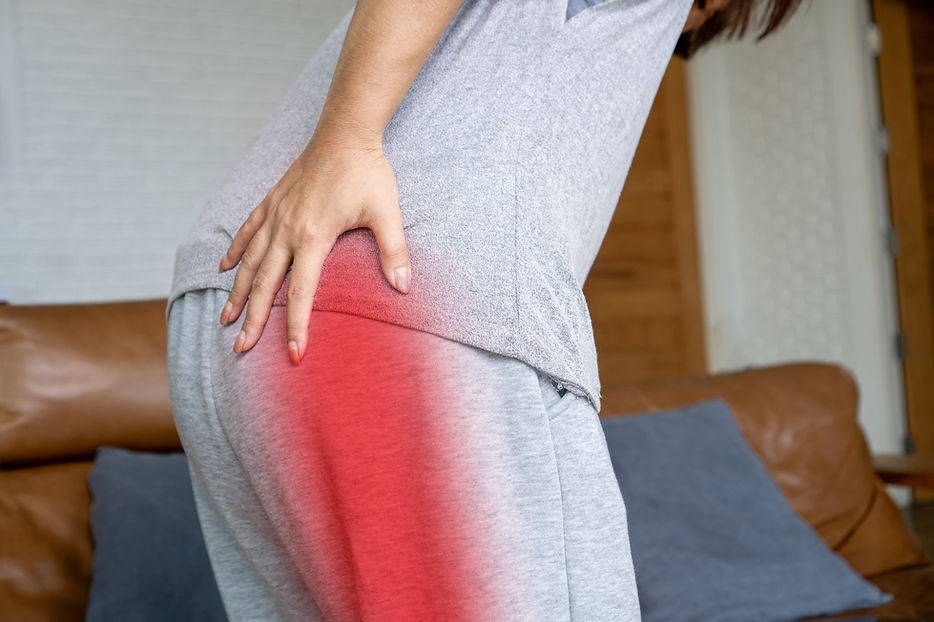
Sciatica
Pain and tingling from the lower back to the leg is rarely a problem of the sciatic nerve alone.
Radiating pain, numbness, or tingling in the buttock or leg—
commonly called “sciatica”—
is not usually caused by direct compression of the sciatic nerve.
In reality, sciatica often arises from a complex interaction of:
-
Tension in visceral membranes (serosa, mesentery)
-
Reflexive muscular tightness driven by autonomic stress
-
Fascial adhesions and impaired tissue gliding
-
Dysfunctional breathing and disturbed intra-abdominal pressure
-
Sacroiliac joint mechanics and pelvic organ influences
-
Postural habits and core coordination patterns
These interconnected factors often create pain even when X-rays or MRI show “no abnormality.”
■ Sciatica is not caused by a “problem in the sciatic nerve itself.”
The true issue lies in the disturbed environment around the nerve.
The sciatic nerve travels from the lumbar spine, through the sacrum and buttock,
down to the thigh, calf, and foot.
When the surrounding structures lose balance, pain can appear through several mechanisms:
1. Visceral membrane tension (ascending/descending colon, kidneys) and reflex pathways
-
Right-sided sciatica → tension in the ascending colon
-
Left-sided sciatica → tension in the descending colon
Visceral strain can produce reflex tightening in the:
-
Piriformis
-
Psoas major
-
Quadratus lumborum
This narrows the space where the sciatic nerve passes and can easily cause:
-
Piriformis spasm
-
Compression at the nerve outlet
-
Pain or tingling radiating down the leg
2. Fascial adhesions impair the “sliding tunnels” through which the sciatic nerve travels
The sciatic nerve runs inside fascial compartments.
When fascial gliding is restricted, the nerve is pulled, irritated, or compressed.
Key fascial structures include:
-
Toldt’s fascia (strongly involved on the right side)
-
Retroperitoneal fascia
-
Iliac fascia
-
Transversus abdominis fascia
-
Piriformis fascia
These structures connect the lumbar spine, pelvis, hips, intestines, and diaphragm—
which is why sciatica cannot be solved simply by massaging the buttock.
3. Diaphragmatic tension and disrupted abdominal pressure distort the lumbar–sacral mechanics
A stiff diaphragm
↓
Irregular intra-abdominal pressure
↓
Chronic tension in the psoas, iliacus, and piriformis
↓
Sciatic nerve irritation and recurrent symptoms
Because the diaphragm is linked to the liver, stomach, and kidneys via ligaments,
visceral stress often leads to breathing dysfunction → pelvic imbalance → sciatica.
4. Sacroiliac joint (SIJ) mechanics and pelvic organ tension
The sciatic nerve runs close to the anterior sacrum.
Even a subtle shift in sacral position or tension from:
-
Intestinal membranes
-
Bladder fascia
-
Uterine ligaments (in women)
-
Rectal mesentery
can directly increase neural tension.
Although rarely discussed in most clinics, this region plays a critical role in true sciatica.
✔ **Conclusion: Sciatica is not a “local problem.”
It is a whole-body coordination dysfunction.**
This is why:
-
Massage
-
Electrical stimulation
-
Stretching
-
Trigger point therapy
often provide only temporary relief and fail to address the root cause.
■ Our Approach
**We do not “force the body to change.”
We create the conditions in which the body can reorganize itself.**
We view sciatica not as a buttock or leg problem,
but as the downstream result of a disrupted whole-body system.
◆ Comprehensive evaluation of visceral–fascial–neural interactions
We assess:
-
Tension in the ascending and descending colon
-
Kidney mobility and positional strain
-
Retroperitoneal fascial gliding
-
Diaphragmatic stiffness
to identify the true origin of your symptoms.
◆ Restoring fascial gliding
Rather than using strong pressure,
we identify points where the body naturally begins to release—
allowing the fascial network to regain smooth, coordinated movement.
◆ Reducing neural load
We calm autonomic overactivity, visceral reflex tension,
and sympathetic stress that aggravate sciatic nerve sensitivity.
◆ Re-educating breathing, posture, and core dynamics
When the diaphragm, rib cage, and pelvis regain coordinated movement,
the strain on the sciatic nerve decreases dramatically.
FMT (Functional Movement Therapy) is used when necessary
to restore efficient motor patterns.
■ Sciatica rarely resolves in a single session
Temporary relief is possible,
but chronic or long-standing cases require a gradual, structured recovery process, including:
-
Accurate evaluation
-
Appropriate hands-on intervention
-
Breathing and lifestyle adjustments
-
Movement retraining
▼ For patients currently receiving care at our clinic
A deeper, more technical explanation of sciatica—
including visceral reflex pathways, fascial mechanisms, SIJ dynamics,
and long-term recurrence patterns—
is available in our members-only clinical page.
Topics include:
-
Visceral–piriformis reflex mechanisms
-
Clinical relevance of Toldt’s fascia
-
Pelvic organ fascia and the sacral nerve plexus
-
Interaction of posture, breathing, and sciatic load
-
Principles for preventing recurrence
※ The password is provided only to active patients.
※ Password is available for active patients. Please ask us during your next session.
※ Passwords are changed periodically for security.
■ Contact / Appointments
If you are truly seeking improvement
and want to address the deeper mechanisms behind sciatica,
we will support your body’s natural ability to reorganize and heal.
Important Notes
Our clinic’s explanations include perspectives on visceral tension, fascial dynamics, neural reflexes, breathing mechanics, and postural patterns—
factors that are not always detectable through standard orthopedic examinations such as X-rays or MRI.
The information presented here is based on:
-
Anatomical and physiological principles
-
International manual therapy frameworks (such as osteopathy)
-
Observable, reproducible patterns seen in clinical practice
However, some mechanisms involved in sciatica are part of a field in which
no globally standardized diagnostic criteria currently exist.
Therefore, the content on this page:
-
Includes perspectives that differ from conventional medical diagnosis
-
Does not represent a definitive medical diagnosis
-
Should be understood as a complementary, functional approach that supports the body’s ability to recover
We do not replace medical evaluation, and medical examinations may be necessary depending on the case.
Our goal is to work alongside appropriate medical care when needed,
providing an additional perspective focused on restoring whole-body function.
Sciatica can arise from many different backgrounds, and not all causes apply to every individual.
Pain patterns may vary depending on:
-
Work habits and posture
-
Age
-
Visceral fatigue
-
Stress and autonomic load
-
Activity level and movement habits
-
Past injuries or medical history
For this reason, the mechanisms described on this page represent one example of common clinical patterns,
not an absolute explanation for all cases.
Some people experience sciatica from simple muscular tension,
while others develop chronic symptoms due to multiple overlapping factors.
If you are unsure which pattern your symptoms may belong to,
please do not try to determine it on your own.
We are happy to evaluate your condition carefully
and help you understand what may be contributing to your symptoms.